The Supreme Court has ruled that a Governor cannot send bills to the President for consideration if the state assembly has already cleared them for a second time. The court was questioning the Centre over the powers of the Governor when it comes to granting assent to bills.

The BJP and the Opposition have engaged in a war of words over the implementation of the women's reservation bill, which aims to reserve seats for women in legislatures. The bill was defeated in the Lower House, leading to accusations and counter-accusations between the parties.

Tamil actress Trisha Krishnan issues a strong response to 'inappropriate' comments made by a BJP leader, asserting her neutral political stance amidst controversy linking her to actor Vijay.
Tamil actress Trisha Krishnan issues a strong response to 'inappropriate' comments made by a BJP leader, asserting her neutral political stance amidst controversy linking her to actor Vijay.

Several opposition parties on Wednesday decided to jointly oppose the delimitation provisions in the Constitution amendment bill in Parliament, even as they reiterated support for women's reservation, with Mallikarjun Kharge alleging the move is politically motivated.

Union Parliamentary Affairs Minister Kiren Rijiju announces the debate and vote on the no-confidence motion against Lok Sabha Speaker Om Birla will occur on March 9. The Budget Session's second part will also address important legislation and critical bills.

The ruling NDA alliance has secured a majority in the Rajya Sabha elections, winning key seats in Bihar, Odisha, and Haryana, while other candidates were elected unopposed across multiple states. The elections were marked by cross-voting allegations and political maneuvering.

Senior DMK leader I Periyasamy reiterated that Chief Minister M K Stalin is firm against sharing power with allies, dismissing any possibility of a coalition government in Tamil Nadu.

'We will give Rs 25,000 to parents having a second child or more at the time of delivery itself.'

Karnataka Governor Thaawarchand Gehlot has refused to address the joint sitting of the state legislature, prompting government intervention. The reasons are unclear, but follow similar incidents in other states.

'It makes law-making on the part of the state governments much more difficult and throws up bottlenecks as governors are not acting on bills.'

Actor-politician Vijay announced his retirement from cinema at the audio launch of his movie 'Jana Nayagan' in Malaysia, citing his dedication to his fans. The event, attended by nearly 1 lakh fans, featured emotional speeches and performances, marking Vijay's farewell before his political career.

Both Mr Modi and Amit Shah like Nabin because they know he will never answer back, points out Aditi Phadnis.

''Women are coming into public spaces in larger numbers than ever before. They are educated, capable, opinionated, and determined.' 'But the more women push for access to public space, the harder they are pushed back -- through attacks like this, through discrimination, through the glass ceiling, through the deliberate denial of recognition.'

BJP-ruled states argued in the Supreme Court that governors and the President have autonomy in assenting to bills passed by state assemblies, asserting that courts cannot mandate assent.

India's vote on the Sri Lanka resolution in Geneva may well have speeded up the general elections in the country and reduced our effectiveness as a regional power, says TP Sreenivasan

The debate over working hours flared up after Infosys Co-founder N R Narayana Murthy called for 14-hour workdays.

In a landmark verdict, the Supreme court fixed a timeline for Governor to act on bills passed by the state legislature as it pulled up Tamil Nadu Governor R N Ravi for reserving 10 bills for President's consideration, saying it was against the constitutional provisions.
The raids were in progress at the premises of former Assembly Secretary M Selvaraj, then Committee Officer P S K Singaravelu, Section Officer, S Balakrishnan, and then Joint Secretary K Indira, Directorate of Vigilance and Anti-Corruption sources said.
The Supreme Court of India has ruled that no timelines can be imposed on governors and the president to grant assent to bills passed by state assemblies, clarifying the extent of their powers under Article 200 of the Constitution.

The Tamil Nadu assembly on Thursday once again unanimously adopted the bill to ban online gambling, weeks after state Governor R N Ravi had returned it to the government for its reconsideration.

The Tamil Nadu assembly on Monday adopted a resolution to urge the Centre and the President to fix a timeframe for state governors to approve bills adopted by the respective houses.

'Previously, contributing only 25 per cent of material costs, states now face burdens of 40 per cent to 100 per cent of total costs, ensuring poorer states will curb project approvals, directly stifling work demand.'
What was the "locus standi" of Sonia Gandhi when she along with the then prime minister Manhoman Singh inaugurated legislative buildings in Manipur and Tamil Nadu, the Bharatiya Janata Party asked on Wednesday while countering the Congress's criticism over the inauguration of the new Parliament building by Prime Minister Narendra Modi.

The Supreme Court of India has agreed to hear on May 6 the pleas of the Kerala government against the governor over the delay in approving bills passed by the state assembly. The court will consider whether the issues raised in the Kerala petition are covered by a recent judgment on a similar plea by Tamil Nadu, which set timelines for governors and the President on granting assent to bills.

Tamil Nadu Chief Minister M K Stalin has announced that the state's Assembly resolution seeking NEET exemption, which was sent for Presidential assent, has been declined by the Centre. Stalin termed the rejection as a "dark chapter in federalism" and accused the Centre of disregarding the will of the Tamil Nadu people. He also announced an all-political party meeting on April 9 to discuss the issue further.

EVMs can't be used in presidential, vice-presidential, or Rajya Sabha polls because they only count simple votes, not the preference-based system needed for these elections.
The Centre has opposed the imposition of fixed timelines on governors and the President for decisions on bills passed by state legislatures, arguing that such constraints were intentionally omitted by the Constitution's framers.

The Supreme Court has questioned the practice of Governors withholding assent to bills indefinitely, stating that it renders the constitutional provision of 'as soon as possible' meaningless.
A bench comprising Justices J B Pardiwala and R Mahadevan said, "He (the governor) seems to have adopted his own procedure. He says, 'I withhold assent, but I will not ask you to reconsider the bill'. It does not make sense to keep withholding assent and not send it to the legislature, thereby frustrating the provision of Article 200."
The Centre has told the Supreme Court that imposing fixed timelines on governors and the president to act on bills passed by a state Assembly would amount to one organ of the government assuming powers not vested in it by the Constitution and lead to a "constitutional disorder".

The other three crore -- nearly 40 percent -- will have to provide one of the 11 listed documents to establish their place or date of birth.

The governments of Tamil Nadu and Punjab have moved the Supreme Court alleging delay by the state governors in giving assent to bills passed by the respective state assemblies.
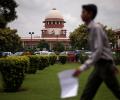
The Tamil Nadu government has argued in the Supreme Court that Governor R N Ravi's repeated withholding of assent to bills passed by the state legislative assembly would lead to the failure of the democratic system in India. The top court has questioned the delay by the Governor in granting assent to several bills passed by the state assembly and asked why governors should wait for parties to move the court with their grievances. The court has also said that the Governor cannot refer bills passed by the legislature and re-adopted by it for presidential assent.

The value of the vote of a member of Parliament has gone down to 700 from 708 in the presidential poll scheduled for July 18 due to the absence of a legislative assembly in Jammu and Kashmir.

The Supreme Court raised concerns about a potential stalemate in Tamil Nadu due to the Governor's delay in assenting to bills passed by the state assembly. The court questioned the Governor's actions, noting that he should have communicated his concerns about the bills' constitutionality to the state government. The case focuses on the delicate balance of power between the state government and the Governor, highlighting the importance of open communication and transparency in the legislative process.

A high-level committee on Thursday recommended simultaneous elections for Lok Sabha and state assemblies as the first step followed by synchronised local body polls within 100 days.

Four days after the top court cleared 10 bills, which were stalled and reserved by Tamil Nadu Governor R N Ravi for the president's consideration, and set a timeline for all governors to act on the bills passed by the state assemblies, the judgement running into 415 pages was uploaded on the apex court's website at 10.54 pm on Friday.

Tamil Nadu Chief Minister M K Stalin has welcomed the Supreme Court's ruling that state governors must give assent to bills passed by state assemblies, calling it a 'historic' victory for all state governments in India. The court's decision came after the Governor of Tamil Nadu, R N Ravi, withheld assent to several bills passed by the state legislature. The court found that the governor's actions were in violation of the Indian Constitution, which mandates that governors must act on the advice of the council of ministers. The ruling is seen as a significant step towards strengthening the federal structure of India.

Vijay, despite the loud message from his delayed arrival at the road-show/stampede venue, and more so his continued inaccessibility for fans-turned-cadres after graduating from a super-star to a political party leader with electoral ambitions, refuses to change. Or, so it seems, observes N Sathiya Moorthy.
